The Doll’s Head Trail is a grassroots, low-art installation nestled within a Southeast Atlanta wildlife preserve. Constructed by volunteers and visitors from decades of environmental debris, the trail converts waste into folk art-inspired “junk” displays. The creative upcycling ranges from a miniscule shrine to “Toxic Masculinity” to a stark shoe pile commemorating child gun violence. This article details how queer theory’s “temporal turn” provides insights into material performance as collaborative regeneration. The curious vignettes playfully invert hierarchies, revealing the merits of small-time memorialization. Through these defiantly unofficial grassroot performances, the Doll’s Head Trail both remembers and restores community ruins, demonstrating the aesthetic and political potential of low-art material performance.
Tom Fish is Assistant Professor of Theatre History and Theory at Kennesaw State University. His articles and chapters have appeared in Theatre Symposium, Religions, TAJ: Studies in Scenography and Performance, Ecumenica, The Journal of Religion and Theatre, and Routledge’s Milestones in Queer US Theatre. He is an active production dramaturg and serves as Resident Dramaturg at Kennesaw State.
Introduction: Restorationland
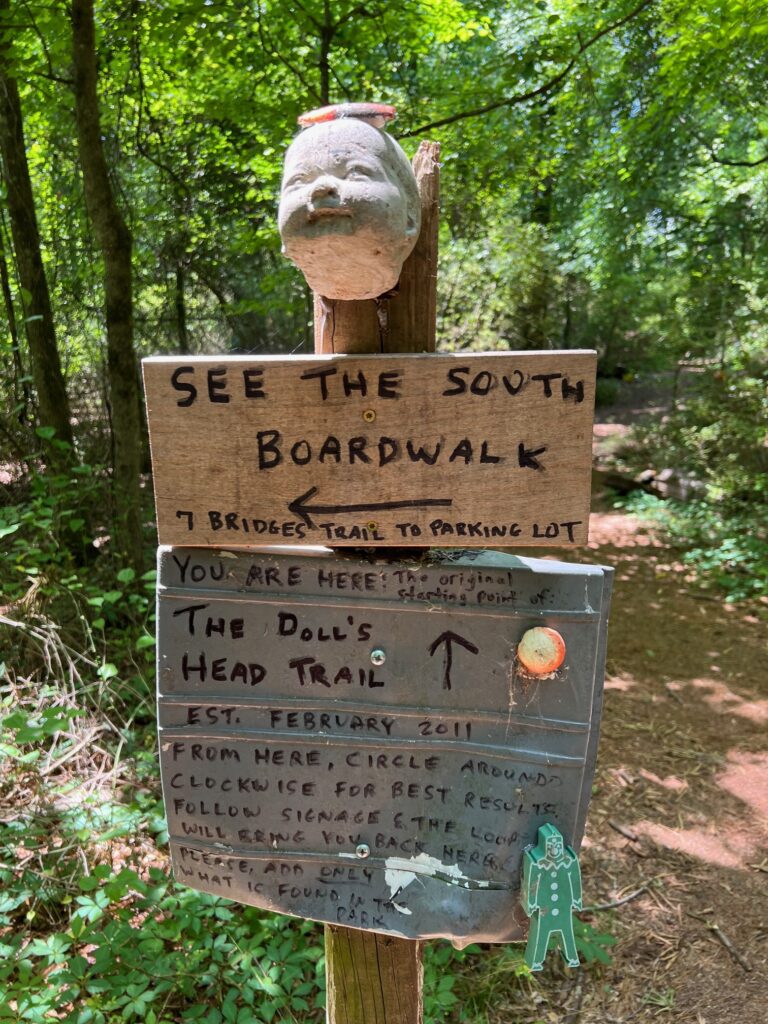
Tucked away in a public wildlife reserve in Southeast Atlanta, the Doll’s Head Trail is a community-based, low-art exhibit made entirely from found materials. I first heard about the site from a colleague, and its eerie title drew me to investigate. Hidden in Constitution Lakes Park, behind the two lakes that give the park its name, I followed along to the base of the forest trail until I encountered a weathered welcome sign with a ceramic-looking mold of a baby’s head affixed to the top (Figure 1). A handwritten note identified the marker as the “original starting point” of the trail and the month and year it was established: February 2011. As I ventured further, I uncovered a creative landscape of upcycled trash emerging out of Atlanta’s ruins.[1]
I stumbled upon two discarded kitchen pans and the base of a used blender lying on the ground. Nearby, a brick labeled with ink marking ironically titled the objects: “Trendy Outdoor Kitchen.” Later, I discovered a display with a plastic baby toy bicep—perhaps one inch long—resting on a wooden plank. Next to it sat a discarded container of Old Spice deodorant and an assortment of plastic litter. The board carrying the trash bits was elevated by a scaffolding of brick, like a makeshift, toddler-sized shrine. Through its whimsical portrayal, the collection of objects highlighted environmental degradation alongside an ironic statement on gender norms. The juxtaposition of the deodorant—a brand known for taglines like “smell like a man”—with the miniature bicep, was brought into ironic relief. On the left of the plank, scrawled on a scrap of brick, read the words: “Toxic Masculinity.” This low art had been endowed with cheeky meaning, but the discards also functioned as a mode of material performance. They broadened the realm of classic puppetry in bearing “visual and kinetic meanings that operate independently of whatever meanings we may inscribe upon them in performance” (Posner, Orenstein, Bell 2014: 5). Their weathered appearance, shaped by years or decades of natural and human factors, performs a role as out-cast objects, while also serving as environmental critique.
The Doll’s Head Trail was first envisioned by Joel Slaton, a local carpenter, born and raised within two miles of the site, and a frequent visitor to the forest. The art environment emerged over a decade ago, partly out of Slaton’s frustration with the accumulation of waste he would regularly encounter during hikes in the woods. It also provided a fanciful distraction from his financial and personal stress during the Great Recession as his carpentry business slowed (see Brown 2019). As a lifelong resident of the local community, while frequenting the area for hikes, he began to notice a surprising number of antique children’s dolls, which were particularly resilient to environmental decay. He began to whimsically place doll heads into the hollows of trees. As he uncovered more trash, his efforts expanded and he began assembling creative mashups, combining various toys and debris. Other visitors soon followed suit and, nearly fifteen years later, found objects continue to accumulate. During my first visit, in the summer of 2022, I encountered roughly seventy such displays, but due to the installation’s interactive nature, the number changes frequently. Slaton, now older, has largely retired from manual upkeep of the trail, yet continues to oversee a small team of volunteers on its weekly maintenance.
Although the name, the “Doll’s Head Trail,” quickly caught on, due in part to its eerie allure, Slaton confided, during a personal interview, his own nickname for the art environment: “Restorationland” (Slaton 2022). Although this pet name isn’t outwardly visible along the site, this study draws upon the title to help describe the site’s recuperative aesthetic and politics of play. Ultimately, it argues that the community trash art site, as viewed through the lens of material performance, helps reveal its aesthetic and social-political potential for grassroots restoration.
Failed Objects
Along the trail, “lost” waste objects have been uncovered and “found.” The humble nature of the materials engages with, even challenges, certain dominant societal norms and capitalist tendencies. It confronts what Tamar Novick and Maria Pirogovskaya term a “waste-value pendulum,” which privileges objects that maximize efficiency and commercial use-value (2025: 6). To reconsider the status of waste, I follow Amelia Jones’ call to “adopt methods to engage with the materialities we encounter” (Jones 2015: 27). This paper, accordingly, draws from queer theory’s “temporal turn” to unpack the curious use-value and political potential of the trail’s low-art objects. Such queer time strategies focus on challenging systems of power and regimes that define value through capital accumulations, normative progress, and patrilineal futurity.[2]
Jack Halberstam’s The Queer Art of Failure asks, “what kinds of reward can failure offer us?” (2011: 3). His critical, queer methodology centers on a playful recuperation of bygone objects and overlooked archives. Drawing on Antonio Gramsci’s concept of “low theory,” Halberstam proposes tactics that deviate from official canons and the prestige of high art, embracing instead the naïve and nonsensical (2011: 12). His case studies include so-called low art forms and outcast subjects, from SpongeBob SquarePants to the silly stoner film, Dude, Where’s My Car? (2000). Ultimately, Halberstam’s framework shows how material archives of failure lend themselves to collective redefinitions of “success,” challenging dominant notions of what type of matter matters.
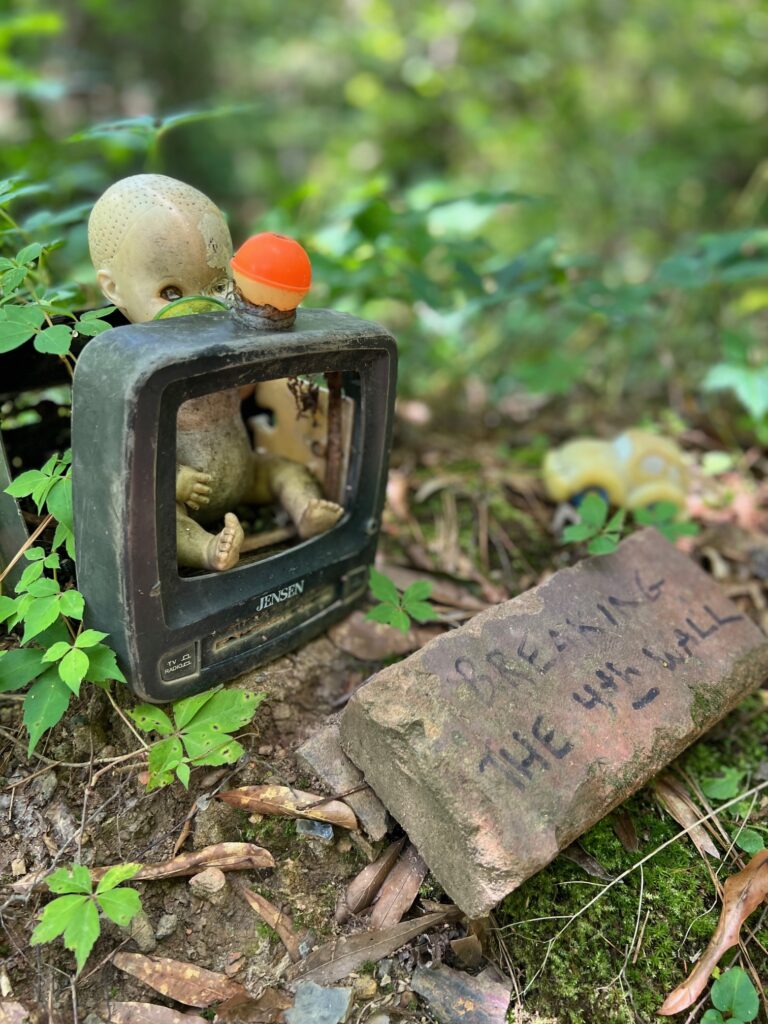
The unskilled arrangement of discarded objects may register as low brow art or to some people not even strike them as art at all. Its displays are blatantly amateurish and unpolished, generating their own aesthetic—and humor—through a performance of failure. The “Trendy Outdoor Kitchen” is funny largely because of how untrendy it actually is. The Doll’s Head Trail as “theatre” is defiantly public, operating as a kind of playground for material animation. Visitors are invited to participate firsthand, becoming artists themselves on a whim. While the object-displays may not be live in a traditional sense, they nonetheless perform legacies of human presence through their construction, abandonment, or imaginative restoration. The natural environment plays an equally vital role, weathering and reshaping the waste materials and enriching their co-creative potential.
Restorationland is invested in reviving objects that have lost conventional use-value. In Vital Matters,Jane Bennett explores how even “dead stuff” may possess a kind of “energetic vitality” (2010: 5). Writing about the trail for Liminalities, Nicole Costantini likens the mash-up displays to Bennett’s idea of assemblages—compositions in which objects “appeared as things, that is, as vivid entities” (Bennett 2010: 5, emphasis in original). Bennett enlivens things like a work glove, a bottle cap, and a smooth stick of wood (2010: 4). Similarly, the trail enlivens kitchenware, baby toys, and discarded toiletries.
By contrast, I interpret the trail’s aesthetic as one less focused on the primacy of objects themselves and more on co-creative storytelling. Its vignettes foreground the human subject, not only as assembler or viewer but as part of a shared narrative. The “Toxic Masculinity” display may feature junk objects, but it also comments on people and the performance of gender. The waste-based displays are also shaped by cultural conventions and draw from the practices of Southern folk art. In this way, Restorationland mobilizes a living history that bridges the material, environmental, and human.
Afterlives of Objects
Jeremy Walton and Çiçek Ilengiz use the term “material afterlives” instead of “ruins” or “waste” to emphasize the enduring liveliness of objects. They ask: “What lessons might we glean from the objects that remain after a subject’s vitality has ebbed?” (2022: 348). While I use terms such as junk, trash, or ruins to describe the trail’s objects, my focus, likewise, centers on their afterlives, particularly their embodied history and relationship to the past. Though lacking commercial value, these objects offer what Jones calls “material trace” (Jones 2015: 34). The trail’s junk challenges the perception of trash objects as merely passive or inanimate, in part by reviving historical and imaginative associations.
Elizabeth Freeman, in a mode akin to Halberstam, unearths culturally and politically charged histories of failure as queer political methodology. Her theory of “temporal drag” serves as an anti-genealogical means of “archiving culture’s throwaway objects … from which usable pasts may be extracted” (2010: xxii). For instance, trash along the trail may acquire aesthetic use-value when structured into a display like “Trendy Outdoor Kitchen.” It may also gain sociopolitical use-value when viewed within a broader historical context. Most of the trail’s materials originate from decades of pollution overflow, largely from the nearby South River, which runs through an historically lower-income Black community.[3] Lisa Woynarski’s concept of “intersectional ecologies” provides a useful framework here. By considering queer perspectives on urban waste and renewal alongside racialized histories, I aim to “interpret ecodramaturgical practices, foregrounding marginalized perspectives” (2020: 6). From this angle, the trail becomes a generative site for mobilizing sociopolitical vitality out of Atlanta’s ruins.
Experiencing the Trail
In a personal interview, Slaton described the trail’s mash-up objects as “vignettes,” though he quickly added that the French-sounding term felt too highbrow for such low art (Slaton: 2022). Nevertheless, the term captures how the trail’s junk objects, assembled through environmentally forged interactions, are far from static. They function as episodic storytelling moments. Mapped non-sequentially along the path, they invite visitors to wander according to their personal whim.
The trail is commonly estimated at 1.5 to 2 miles, though this includes the broader hiking terrain. The specific area referred to in this study—the part composed of vignettes—is considerably shorter, concentrated by curves and loops. Visitors are not guided along a clear, linear route. Instead, they are invited to get lost in the trail’s non-sequential logic, turning exploration into a playful hunt for creations. Sara Ahmed reminds us that the etymology of queer links to the word “twist.” Visitors’ routes twist orientations between bodies and others—whether objects or nature—rather than traverse “straight” ahead (Ahmed 2006: 67). The embodied act of walking the trail is central to this improvisational experience. Forest-goers chart their spatial moves as personalized “turns of phrase,” forging tracks that can be new, accidental, or well worn (Certeau 1984: 99). With its open structure, time spent on the trail varies: my first visit lasted about forty minutes, but one might imagine anything from a brief ten-minute jaunt to over an hour of immersive exploration or hands-on vignette creation.
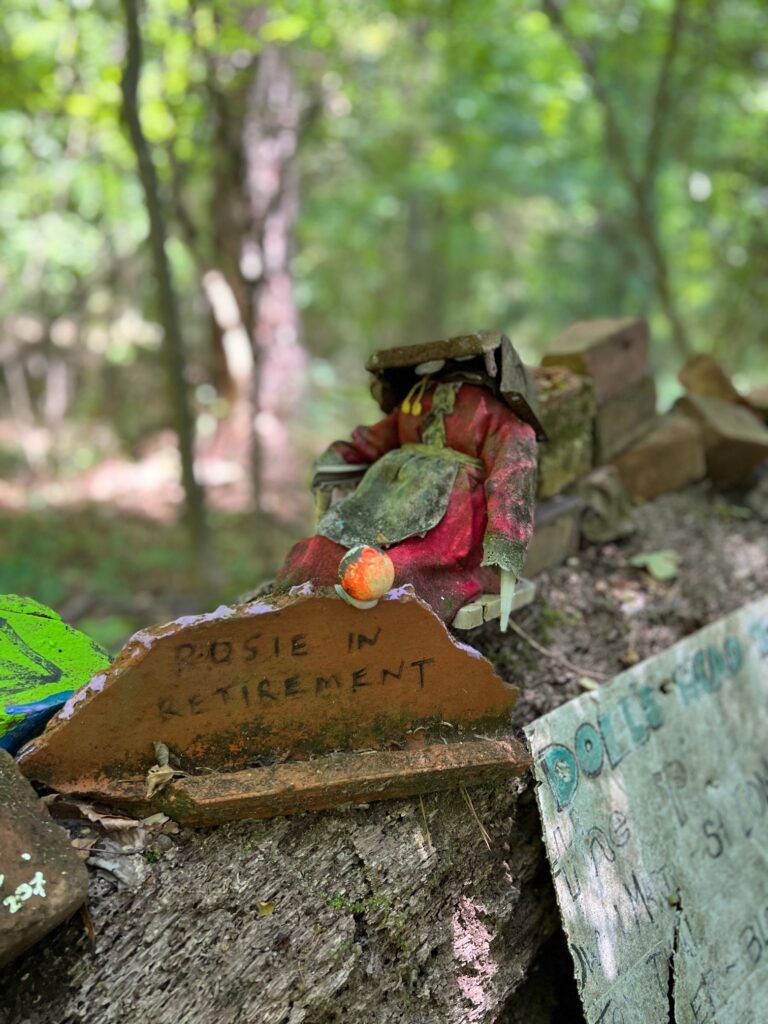
According to Slaton’s estimates, the trail has averaged around two hundred visitors per week over the years, totaling in the tens of thousands (Slaton 2022). Despite this, it has remained a grassroots effort, lowbrow enough that visitors feel welcome to participate. The trail draws on folk and “outsider” art traditions. Leaning on a downed tree, I found a faded board citing the trail as “in the spirit” of historic Georgia-based folk artists. Names included whirligig enthusiast R. A. Miller, pastor-folk artist Floria Yancey, and Eddie Owens Martin (St. EOM), known for his art-environment Pasaquan near Columbus, Georgia. The list links the trail’s DIY ethos to a Southern lineage of eccentric, creative folk artists.
Slaton embodies many traits of an outsider artist himself: self-taught, working by hand, and repurposing everyday objects. His bricolage approach, mixing and matching found objects in an impromptu style, challenges dominant artistic norms. Like the trail itself, his creative method resists “linear, sequential thinking, narratives, and practices” (Whiteley 2011: xii). As Joan Benedetti notes, folk art is often—though sometimes problematically—understood as anonymous (2000: 16–17). The trail, instead, emphasizes collective identity or co-production over individual authorship. Slaton’s name does not appear along the trail, and the trash objects themselves, as public and unowned, foster anonymity. In addition, the South River Forest wildlife reserve allows the natural environment to flourish without strict human oversight. Visitors are thus free to lose themselves in the trail’s topsy-turvy logic—akin to how Shakespeare’s Forest of Arden operates through anonymity and transformative play. Collectively, these elements reinforce the trail’s grassroots character and its liberatory outsider aesthetic.
Rinky-Dink Animations
The title Restorationland emphasizes the project’s regenerative ethos, with the suffix “-land” evoking childlike associations akin to Disneyland, Candy Land, or Barbie Land. A sense of wonder permeates the trail as visitors uncover junk-art treasures, like a broken teacup atop a pile of bricks, inscribed with the phrase: “We’re all quite mad here, you’ll fit right in.” The Alice in Wonderland reference aligns with the trail’s playful inversion, with curious objects contrasting with the magnitude of the surrounding forest.
The installation evokes the feeling of an Easter egg hunt—one aimed at discovering trash treasures. Miniature objects and toys, often paired with ironic labels, humorously comment on their own smallness. At the end of a log, a collection of colorful bobbers and a cat toy are assembled with a sign labeled: “Scale model of an unknown solar system.” Elsewhere, beneath a leafy canopy, a line of toy emergency vehicles bears the caption: “Convoy.” The “Rinky-Dink Circus” features junk bits as suspended performers, plastic animals as a makeshift zoo, and a miniature version of a Tilt-A-Whirl ride. The trail invites a juvenile imagination that privileges creative invention over commercial value.
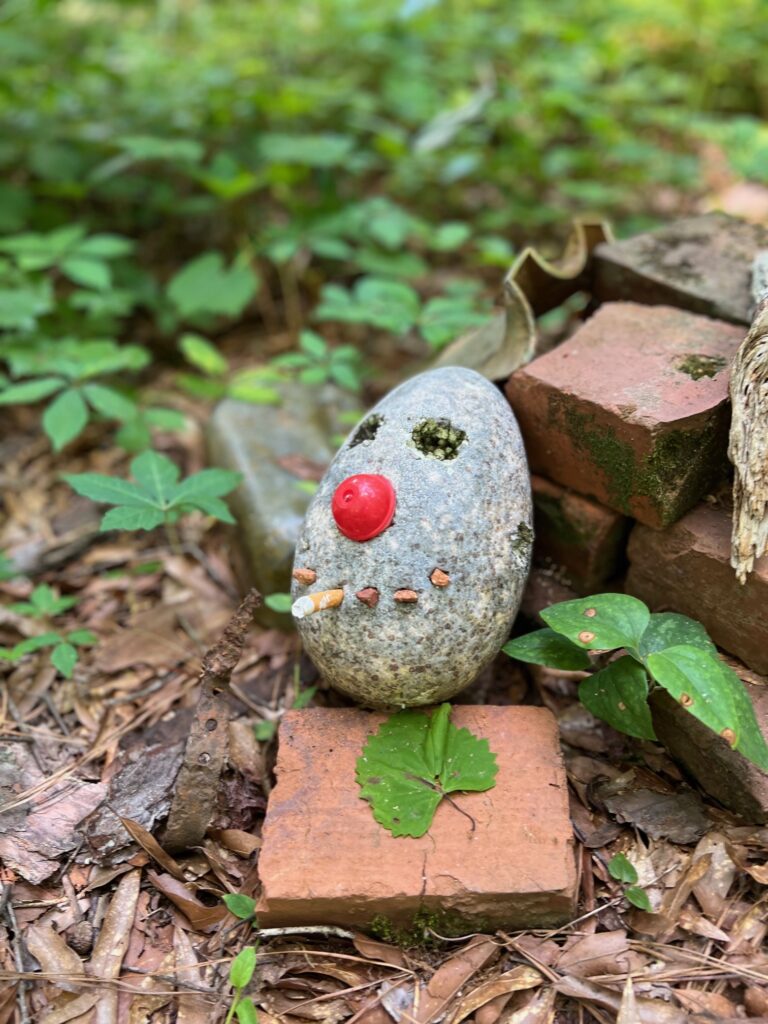
Drawn by the trail’s name, visitors may arrive less with whimsy than with suspense, expecting an eerie walk among morbid children’s toys tucked in a secluded corner of the woods. This affective charge is often amplified by blogs and local journalism. Slaton recalls an interview in which the trail’s ecological critique and playful aspects were overlooked in favor of sensationalism; the article ultimately ran with the headline: “It’s Halloween in June” (see Buccy 2022). On social media and in local press, the trail is often depicted through close-up, high-resolution images that render a cinematic look for maximum clickbait appeal. Under this lens, the environmental waste appears like forensic evidence in a detective thriller or as stills from a horror film.
In person, however, the apprehension tends to fade. Set against the expansive woods, the installations often appear more miniscule than menacing. Plastic doll heads are a recurring feature (I counted nine on my last visit), but they are dispersed among a much wider array of found objects. Over time, many have even been curated with tongue-in-cheek humor. One vignette displays a splayed doll with wooden peg legs beside a brick labeled: “Linda Blair Witch Project.” The silly portmanteau merges The Exorcist actress with the indie horror film, humorously undercutting the horror of dismembered doll parts abandoned in the forest. Through ludicrous juxtaposition, the animated objects shift from horror aesthetic towards camp.
Queer as Folk Art
On one side of the path, I spotted a large, doughnut-shaped metallic plate inscribed with the words “Glory Hole.” The low-art object, hidden in the woods, offered a playful nod to the forest as a liberatory site for cruising. The phrase gestures cheekily toward gay identity, but also embodies queer aesthetics on multiple fronts. The silly inscription performs what Sara Warner calls an “act of gaiety,” uncovering humor within an otherwise unassuming piece of trash (Warner 2012). As visitors to the trail, aren’t we all, in some sense, searching for anonymous encounters in a secluded pocket of the woods?
As a queer performance scholar, Warner identifies the political utility of “gay” tactics, those that pair humor with subversion. These strategies disrupt normative temporality and counter the negative affects (loss, sadness, shame) that often define LGBTQ+ political discourse. As an act of gaiety, the outmoded, circular scrap recalls the bygone pastime of gay cruising, now largely displaced by digital platforms. The trail’s anonymity, between objects and creators, fosters a unique terrain to explore identity.
On my first visit, I encountered a plastic object roughly two feet tall, shaped vaguely like a “T.” A visitor had propped it upright. One label in black marker read “T for Trail”; another said, “T for Texas.” Costantini describes the trail’s interactive objects as functioning “like a performed story” (Costantini 2023: 13), with tone and political meaning shifting through human and environmental interaction.[4] In this view, the trail replaces fixed meanings with ongoing, process-based interplay between people, nature, and the objects.
On a subsequent visit, the “T” object bore a new message in red lipstick reading: “T for Trans.” This material trace invited speculation. Was it written by someone who identifies as trans or an ally, or was it intended as a (perhaps poorly conceived) joke? The lipstick residue marked a performance of gender, while offering a playful, flexible approach to identity. The markings on the “T” were ultimately provisional. At a time when trans identity is under legal and cultural threat, actively being erased from legal status, the vignette offers a flexibility and immediacy in response (see Kim 2025). As an observer, the impact was shaped by the author’s anonymity and the object’s trans/formation. It underscored how outsider art offers political strategies founded in play.
Memorial Playgrounds
The trail’s found objects offer connections to the past, whether through historical remembrance or pop cultural reference, such as Linda Blair and The Blair Witch Project. Along the path, celebrated figures from artists to philosophers to politicians are conjured through handmade vignettes. Near the entrance, beside a welcome sign, a small piece of plastic rests on a log. Inscribed on it is a quote attributed to Martin Luther King Jr.: “If I can’t do great things, I can do small things in a great way.” The modest scrap encapsulates the guiding ethos of the art environment, serving as a humble form of memorialization through repurposed trash. Positioned at the top of the trail, the quote prepares visitors not to underestimate their miniature encounters.
Quotations from famous thinkers, musicians, and sports heroes are scattered throughout, ranging from Thoreau’s wisdom to lyrics by Johnny Cash. I found a quote attributed to the Dalai Lama etched on the side of a white bucket. Elsewhere, a discarded toddler’s T-ball bat was marked with “The Hammer,” referencing Atlanta baseball legend Hank Aaron. These festive inversions transform revered figures into toy-like amusements. Yet, at times, the trail’s gestures towards memory resist playfulness. I came across a shard of clay inscribed with “R.I.P.” dedicated to Civil Rights icons C. T. Vivian and John Lewis, accompanied by Lewis’s rallying cry: “Good Trouble.” The trail becomes a public mode of small-time remembrance, challenging assumptions that memorials must be sacrosanct, meticulously designed, or built to endure. Instead, it embraces an ephemeral, playful mode of recuperating performing objects to commemorate the past.
The Symbolic Shoe Department
One display along the trail stands out for its stark relationship to a traumatic past. Titled the “Symbolic Shoe Department,” it features a pile of twenty or more worn children’s shoes. An adjacent sign includes a miniature toy gun and a toddler’s shoe affixed beneath a message reading: “Stop the Killing of our Children!” (Figure 5). Slaton recalls this as one of the trail’s most overtly political low-art installations. The symbolic power of the shoes compels visitors to engage imaginatively with the ongoing crisis of gun violence. For me, it evoked the recent death of a local seven-year-old girl, killed by a stray bullet while sitting in a car after Christmas shopping. Given the trail’s location in South Atlanta, the installation may also call up memories of the Atlanta Child Murders (1979–1981), when multiple children were abducted—and at least one body was found near the adjacent South River.
Rather than monumentalize, the power of this vignette lies in its smallness. Surrounded by whimsical displays, its theatrical force is heightened through contrast. Its emotional gravity emerges from humble materials. The shoes echo symbolic forms used in Holocaust memorials, where the absence of bodies marks an enormity of loss. Vivian Patraka, in Spectacular Suffering, develops the concept of “goneness” to describe such encounters. Goneness, she writes, is “…what opens up, what spurs, which unleashes the perpetual desire to do, to make, to rethink” (1999: 7). The shoe pile unleashes a similar impulse, not through formal commemoration, but through low-art performance. It offers a grassroots way of reckoning with local legacies of grief and violence.
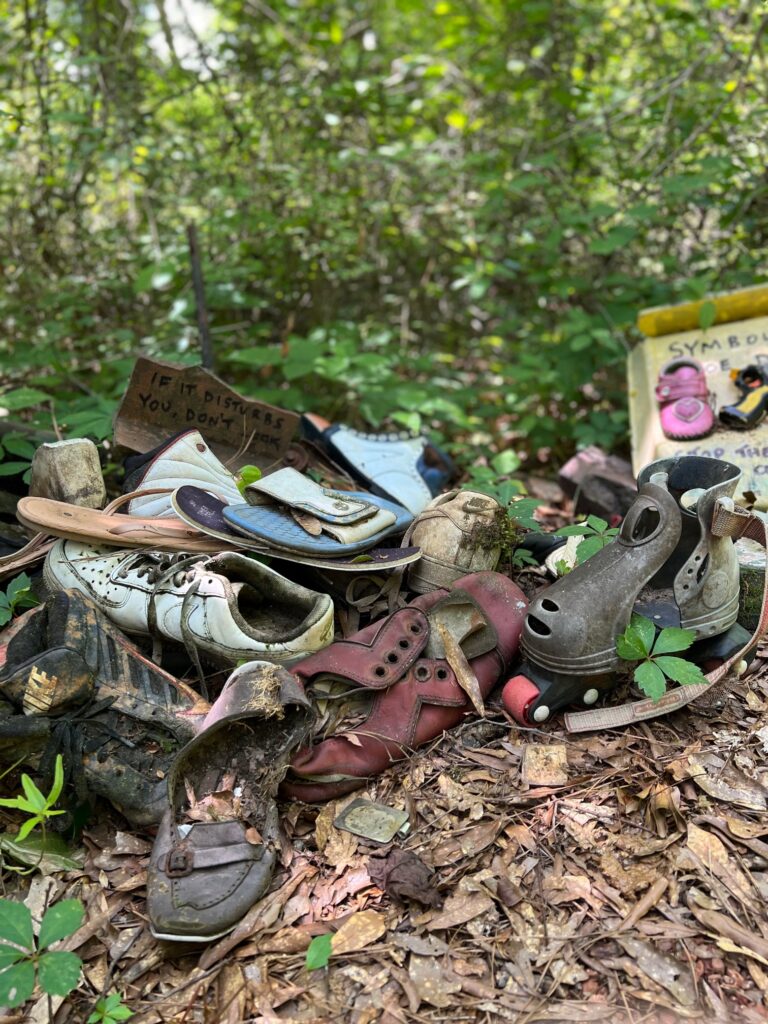
Crucially, the display does not only orient viewers towards the past, it also confronts them in the present. The worn condition of the shoes, their small size, and the pile’s informal arrangement all convey a vulnerability associated with childhood. Although not explicitly stated, the metaphor of loss resonates with the disproportionate toll of gun violence on Black children in Atlanta. Nearby, a brick bears a warning: “If it disturbs you, don’t look.” The phrase is direct—even confrontational—implicating the passive observer who would rather turn away from the symbolic record. The vignette recalls the city’s past violent histories while adding what Patraka calls a “dimension of accountability” for contemporary audiences (1999: 7).
The Symbolic Shoe Department, through its humble remnants, reveals how certain human lives—and associated objects—are valued or protected more than others (Schneider 2015: 13). While New Materialism emphasizes how all matter matters, the shoe pile underscores the hierarchies that remain in cultural valuation. The debris performs its own “temporal drag,” carrying affective weight of social inequity, whether as a symbol of violence, as a surplus of capitalist excess, or as residue of environmental racism. From this perspective, the trail’s junk art becomes a living archive of what Atlanta has physically and symbolically lost and found. Rather than dwell passively in failure or sanitize the past, it kindles from discarded remains a “desire to do, to make, to rethink.” The shoe pile refuses to be a “passive substance intrinsically devoid of meaning” (Gamble, Hanan, and Nail 2019: 111). Quite the opposite: its aesthetic power and political charge emerge from playing in the ruins, where human, object, ecological history, and affect converge.
Legacies of Brick
Although easy to overlook, the humble Toxic Masculinity shrine described earlier is elevated by small piles of discarded brick. The performance, with its ironic humor, stems in large part from the makeshift brick scaffolding that creates its pedestal. Similarly, brick frames vignettes like the Wonderland teacup and serves as a canvas for clever taglines. Digging into the cultural and material histories of Atlanta’s brick further inform the trail’s political and aesthetic work.
Much of Restorationland’s detritus arrived via local river runoff, but the trail also sits beside former railroad tracks and, for decades, served as an informal dumping ground for passing trains. Furthermore, its footprint rests atop the ruins of the former South River Brick Company. The factory’s remains are repurposed along the trail to frame and punctuate vignettes and line the path with rubble baked into the soil. The material history of this brick bears both literal and symbolic ties to Atlanta’s nefarious history of convict leasing. In the aftermath of the Civil War, Georgia leveraged its brickmaking industry to rebuild economically by popularizing the use of incarcerated labor, granting private companies “complete authority over their lives and labor” (Berry 1991: 2). Viewed through an historical materialist lens, the trail enacts a community-based practice of intersectional ecology, intervening into decades of environmental degradation and racial injustice.
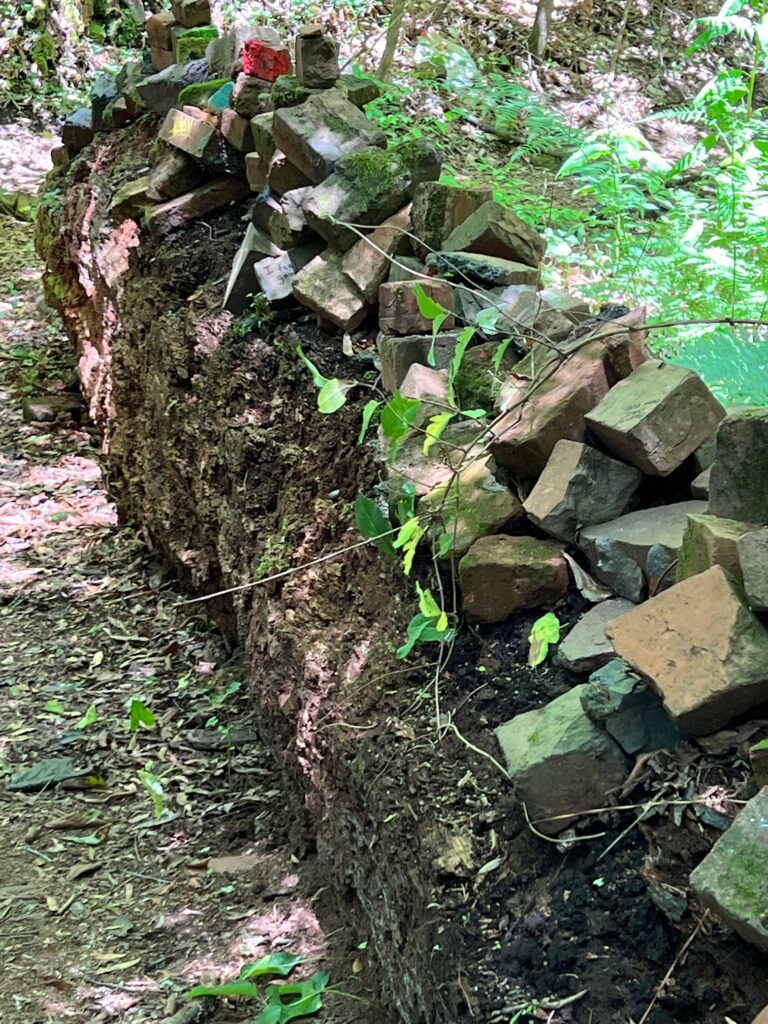
The area now known as the South River Forest was originally the site of indigenous soapstone production and trade by the Muscogee people. By the late nineteenth century, it became home to the South River Brick Company (Mount 2021). Mining local clay pits, the company produced nearly seven million bricks a year by 1897 (Lee 2014). These ubiquitous bricks are tied to that legacy and, indirectly, to the convict leasing system that sustained it (for detailed history, see Blackmon 2008). Penitentiaries were leased to business owners who covered major expenses while using inmates as forced labor, often under brutal, unregulated conditions. The system incentivized the arrest of Black men—who made up roughly 90% of those in this neo-slavery system (Berry 1991: 10)—for petty crimes. Popularized in Georgia for roughly fifty years following the war, convict leasing was eventually outlawed in 1908, only to be replaced by the chain gang system, another means of maintaining racially charged class hierarchies.
My research uncovered no direct documentation of convict leasing at the South River site, although after the company’s closure it became a dumping ground for neighboring brick manufacturers. Still, the trail area was inevitably enmeshed in the region’s exploitative labor practices. South River Brick Company struggled financially due to deflated prices set by rival companies profiteering off convict labor. When this effort failed to bankrupt them, the infamous Chattahoochee Brick Company—Georgia’s largest brickmaker and staunchest advocate of convict leasing—took more aggressive steps. It bought up land around Constitution Lake, cutting the South River Brick Company off from their own red clay resources and transportation lines. The weakened company collapsed during the 1907 financial crisis, leaving its brick ruins behind. If historical accounts are correct, South River’s brick might be endowed with a kind of resistant symbolism, as both material and metaphor of opposition to dominant systems of historical racial injustice.
Today, Atlanta is only beginning to reckon with the legacies of its brick-making practices. Following a multi-year grassroots effort, the seventy-seven-acre former site of the Chattahoochee Brick Company, abandoned for decades, will become a memorial park. In September 2022, an acquisition ceremony marked the city’s purchase of the thirty-five-acre site for $27 million. Mayor Andre Dickens outlined plans for its renewal in a public performance of remembrance. Unsurprisingly, the transaction is entangled with big business interests, and no reparations for descendants of the incarcerated have been announced. The officially sanctioned site marks the graves of an untold number who toiled and died through this system of carceral capitalism.[5] Across town, however, the Doll’s Head Trail offers a defiantly lowbrow mode of remembrance—one grounded in grassroots interplay and whimsical inversions.
Poetics of Restoration
As a queer scholar, my own cultural history is bound up in a legacy of brick—its literal and symbolic value, and its role in political performance. I am reminded of the Stonewall Inn and the persistent question animating the Gay Liberation Movement: “Who threw the first brick?” The brick has become a revolutionary symbol of LGBTQ resistance. But as an Atlanta resident and white gay male, it now awakens in me an alternative political resonance—one tied to the often-buried histories of racial injustice. Part of what draws me to the trail is its collaborative, intersectional potential for ecological critique, one that bridges diverse communities of so-called “outsiders.”
The trail’s grassroots spirit is perhaps best captured at the site of a fallen oak. Over the years, visitors have placed bricks atop the tree, amassed a pile of hundreds (Figure 7). Like the interactive trace of T is for Trans, many bricks are inscribed with messages. In neon yellow script, one reads: “Its Chaos—Be Kind.” Another exclaims, like a cheerleader rooting for humanity: “Go Team Humans!” The messages engage a broader collective, functioning as community-based material performances. The brick pile irreverently celebrates—indeed privileges—the haphazard. Another brick reads: “Nothing is normal. The only normal thing is the settings on a whasing [sic] machene [sic].” By preferring sentiment over spelling, the display embraces error as the norm, proudly lowbrow in style. The same brick is signed, fittingly: “Unkown” [sic]. These assemblages echo José Esteban Muñoz’s vision of queerness in Cruising Utopia as a collectivity that touches the past to envision new, brighter futures (2009: 11).
In this vignette, the downed oak becomes a literal stage. Even in its fallen state, the tree is theatrically revived by the brick display. The trail’s history is invariably shaped by its natural surroundings—perhaps none more so than the oak. At its center once stood Atlanta’s tallest documented willow oak, presiding over the South River Forest till it snapped in high winds in 2015. In memorial fashion, a sign documenting the tree’s legacy remains near its base, which still remains. Slaton notes that the tree’s canopy helped nature flourish in the early years of the art installation, drawing visitors to the site. Without that shade, the trail has grown hotter, weedier, and harder to maintain. The grand oak highlights ecodramaturgies at play, where the story of waste intertwines with nature’s own forms of storytelling, and even tree stumps become sites of memorial and renewal.
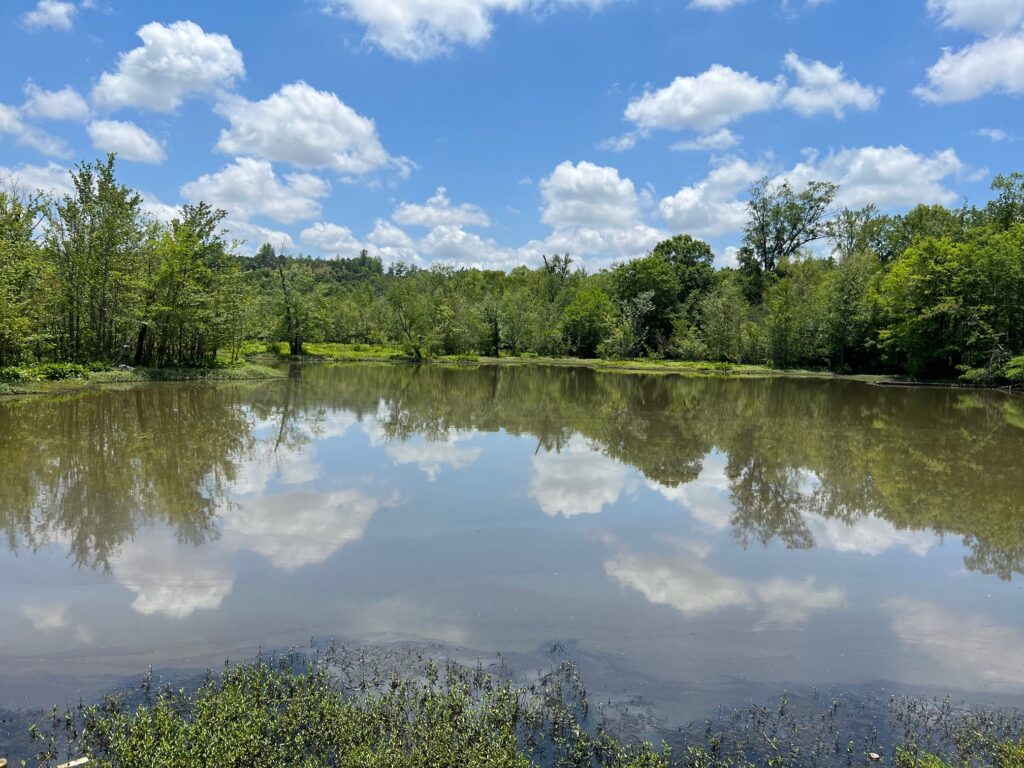
The environmental landscape of Constitution Lakes Park expands the trail’s poetics of restoration. The vast clay pits mined by South River Brick Company eventually became the twin lakes that now define the urban wildlife preserve (Figure 7). Over time, flooding and runoff transformed the pits into bodies of water. While the trail is built atop the ruins of brick production, it also recalls a more recent past: by the late 1950s, the land became home to a Black family who established a business selling bait and supplies—and, by some account, moonshine—overseeing the lakes as a local fishing spot (Lee 2014). According to neighbors, their store was burned down in the 1960s in a racially motivated attack. Today, a small concrete slab remains, possibly marking the site, and a nearby sign simply reads: “Homestead Ruins.” Along the trail, vignettes are marked by Slaton and his crew by attaching colorful fishing bobbers. These bright markers call back to the lakes, but they might also function as a quiet homage to the homestead family as one of the past stewards of the land.
Conclusion
Aptly nicknamed Restorationland, the trail foregrounds regenerative strategies through a politics of play. By celebrating the miniscule, the gritty, and the forgotten, its vignettes embrace failure as an ironically generative methodology. Rooted in an outsider art aesthetic, the trail thrives on a promiscuous interplay of found objects, fellow visitors, and the force of nature itself. With material performances spanning over a decade, it continues to reanimate the vestiges of Atlanta’s past, transforming them into a playground of impromptu grassroots uprising.
Notes
[1] Special thanks to participants at ASTR 2022 “Playing in the Ruins” in New Orleans and Theatre Symposium 2023 “Material Performance and Performing Objects” in Atlanta, Georgia for guidance developing this paper. Their advice helped thread queer theoretical concerns with issues of materialism in performance.
[2] Elizabeth Freeman refers to such regimes as “chrononormativity” (2010: 68), whereas Lee Edelman uses “reproductive futurism” (2004: 11), and José Esteban Muñoz coins “straight time” (2009: 25). Queer theory’s temporal turn dates back to political shifts in the late 90s and the strides in gay politics with neoliberalism. Theorists began to envision queerer relationships to time, progress, and productivity, challenging what Lisa Duggan describes as “homonormativity”: a gay politic that “does not contest dominant heteronormative assumptions and institutions, including commercial practices, but upholds and sustains them” (Duggan 2003: 50).
[3] In 2021, Atlanta’s South River was listed as #4 on the annual “America’s Most Endangered Rivers” report due largely to pollution levels (see McDaniel 2021).
[4] For a thick description of the Doll’s Head Trail focusing on interactive storytelling and a different set of vignettes than the ones analyzed here, see Costantini (2023).
[5] For images of the Chattahoochee Brick Company site prior to the construction of the memorial park, as well as details on the planned development, see Green (2022) and Funderburke (2024).
References
Ahmed, Sara. 2006. Queer Phenomenology: Orientations, Objects, and Others. Duke University Press.
Benedetti, Joan. 2000. “Words, Words, Words: Folk Terminology—Why It (Still) Matters.” Art Documentation 19, No. 1: 14–21.
Bennett, Jane. 2010. Vibrant Matter: A Political Ecology of Things. Duke University Press.
Berry, David Charles. 1991. Free Labor He Found Unsatisfactory: James W. English and Convict Lease Labor at the Chattahoochee Brick Company. Georgia State University, PhD Dissertation.
Blackmon, Douglas A. 2008. Slavery by Another Name: The Re-enslavement of Black Americans for the Civil War to World War II. Doubleday.
Brown, Forrest. 2019. “Possibly the Strangest Hike You’ll Ever Take.” CNN Travel. http://www.cnn.com/travel/article/dolls-head-trail-atlanta-georgia, accessed March 18, 2025.
Buccy, Sawyer. 2022. “Keeping Doll’s Head Trail Creepy for Years to Come.” Atlanta News First. 10 June, 2022. https://www.atlantanewsfirst.com/2022/06/10/keeping-dolls-head-trail-creepy-years-come/, accessed March 18, 2025.
Costantini, Nicole. 2023. “Performance on the Doll’s Head Trail: Co-Creating Experience Through Participatory Installation Art.” Liminalities: A Journal of Performance Studies 19, No. 1 (2023): 1–18. http://liminalities.net/19-1/, accessed March 18, 2025.
Certeau, Michel de. 1984. “Walking in the City” in The Practice of Everyday Life. University of California Press, 91–110.
Duggan, Lisa. 2003. The Twilight of Equality: Neoliberalism, Cultural Politics, and the Attack on Democracy. Beacon Press.
Edelman, Lee. 2004. No Future: Queer Theory and the Death Drive. Duke University Press.
Freeman, Elizabeth. 2010. Time Binds: Queer Temporalities, Queer Histories. Duke University Press.
Funderburke, Stacy. 2024. “Conservation as Racial Justice in Atlanta.” The Conservation Fund. https://www.conservationfund.org/our-impact/projects/atlantas-former-chattahoochee-brick-company-site/, accessed May 19, 2025.
Gamble, Christopher N., Joshua S. Hanan, and Thomas Nail. 2019. “What Is New Materialism?” Angelaki 24, No. 6: 111–134.
Green, Josh. June 27, 2022. “Historic Convict Lease Labor Site Moves Closer to Being New City Park.” Urbanize Atlanta. https://atlanta.urbanize.city/post/chattahoochee-brick-historic-convict-labor-site-new-city-park, accessed March 18, 2025.
Halberstam, Jack. 2011. The Queer Art of Failure. Duke University Press.
Jones, Amelia. 2015. “Material Traces: Performativity, Artistic ‘Work,’ and New Concepts of Agency” TDR 59, No. 4: 18–35.
Kim, Juliana. 2025. “Park Service Erases ‘Transgender’ on Stonewall Website.” NPR. February 14, 2025. https://www.npr.org/2025/02/14/g-s1-48923/stonewall-monument-transgender-park-service, accessed March 18, 2025.
Lee, Conor. 2014. “Doll’s Head Trail at Constitution Lakes.” History Atlanta. https://historyatlanta.com/dolls-head-trail-constitution-lakes/, accessed March 18, 2025.
McDaniel, Piper. 2021. “See Them Now Before They Disappear Forever: America’s 10 Most
Endangered Rivers.” Mother Jones. April 13, 2021. https://www.motherjones.com/environment/2021/04/see-them-now-before-they-disappear-forever-americas-10-most-endangered-rivers/, accessed March 18, 2025.
Mount, Mike. 2021. “South River Brick Company.” Presentation manuscript. Georgia American ndustrial Hygiene Association.
Muñoz, José Esteban. 2009. Cruising Utopia: The Then and There of Queer Futurity. New York University Press.
Novick, Tamar, and Maria Pirogovskaya. 2025. “Introduction: Vital Waste, of the Body Extended.” Journal of Material Culture 30, No. 1: 3–19.
Patraka, Vivian. 1999. Spectacular Suffering: Theatre, Fascism, and the Holocaust. Indiana University Press.
Posner, Dassia, Claudia Orenstein, and John Bell. 2014. “Introduction.” In The Routledge Companion to Puppetry and Material Performance, ed. by Dassia N. Posner, Claudia Orenstein, and John Bell, 1–13. Routledge.
Schneider, Rebecca. 2015. “New Materialisms and Performance Studies.” TDR 59, No. 4: 7–17.
Slaton, Joel. Interview with the author. September 29, 2022.
Walton, Jeremy, and Çiçek Ilengiz. 2022. “Introduction: Afterlives in Objects.” Journal of Material Culture 27, No. 4: 347–58.
Warner, Sara. 2012. Acts of Gaiety: LGBT Performance and the Politics of Performance. University of Michigan Press.
Whiteley, Gillian. 2011. Junk: Art and the Politics of Trash. I.B. Tauris.
Woynarski, Lisa. 2020. Ecodramaturgies: Theatre, Performance and Climate Change. Palgrave Macmillan.

