Phantom Loss. Created and performed by Oanh Vu. Directed by Kurt Hunter. In the Heart of the Beast Puppet and Mask Theater, Minneapolis, MN, March 28–April 7, 2024.
Oanh Vu’s Phantom Loss stands out for its elevation of Vietnamese traditions and their role in a modern American setting. Vu, a Minneapolis-based puppeteer and educator, created and performed in this evening-length puppet performance that balanced cultural understanding and innovative puppet design. The tragicomedy was performed by a team of four puppeteers (Tri Vo, Sofia Padilla, Andrew Young, and Oanh Vu) at the historic Avalon Theater, home of In the Heart of the Beast Puppet and Mask Theater in Minneapolis, Minnesota. Directed by Kurt Hunter, the show featured puppets designed by Vu with mentorship from Hunter and assistance from Orren Fen, Karly G. Bergmann, and Eva Louise Cone Adderley.
While primarily not Vietnamese, the audience was invited into traditional cultural experiences through the world of the play. Vu chose not to educate the audience explicitly about these traditions but instead allowed viewers to engage with them as witnesses, using signifiers of both Vietnamese heritage and 1990s American pop culture. As an audience member, I found myself electing to believe and invest in this complicated world, in which some characters are literally living ghosts. It may be this very oscillation and investment in the puppetry of Phantom Loss that helps cross the cultural divide of time and space and allows for deeper understanding of Vietnamese Americans.
The play begins on the holiday Vu Lan—a time when the ghosts are hungry. Celebrated in Vietnamese Buddhism, this is a festival holiday dedicated to honoring ancestors and expressing appreciation for parental care. In this celebration, there is an implicit understanding that, to understand our future, we must reckon with our collective histories. In Phantom Loss, this serves as an invitation from ancestors not only to remember cultural roots (particularly at a time when pop culture is so prevalent), but to make peace with their continued influence on our lives.
Dressed in black, with bucket hats shielding their eyes from the audience, the team performed a few types of puppets, including marionettes and shadow puppets projected from an overhead projector, used to illustrate and introduce settings. Hunter explored some innovations in the design of the tabletop puppets made especially for this production. Most of the puppets were of this type; standing about 18 inches high, they featured innovative marionette mechanisms with handles on the back to manipulate the legs, attached to the knees by string, that allowed a single puppeteer to effectuate a walking movement. With their tiny faces and clothes, the tabletop puppets were almost doll-like in their appearance. The heads were highly detailed sculptures of papier-mâché, with miniature wigs and costumes that served as important tools for developing the characters’ identities. One, two, or three puppeteers performed each tabletop figure at a time, deftly swapping in and out, sometimes voicing one character while moving another inside the detailed miniature world.
The story unfolds with two main characters, but I identified first with Thuy. A daughter of immigrants who is fully immersed in American pop culture, her positional angst is expressed in her costume—green plaid pants, a black shirt with safety pins, and a streak of green in her hair. She is a young punk who feels out of place and caught between the world of her parents and the world of her peers. The night of Vu Lan, Thuy is at home, complaining about her chores, when she is visited by her deceased grandmother, who appears in the form of a floating head in a vanity mirror. The shift of puppet styles from a gravity-obeying tabletop figure to a floating head with trailing fabric emphasizes the ephemeral nature of Grandmother’s visit, which is later echoed in other characters’ arrivals, and contrasted with the movement of humans like Thuy.
Later, in her backyard, Thuy is met by a hungry ghost in the form of a dog named Chicken, the play’s second main character. This puppet, a marionette voiced and animated by Tri Vo, uses gravity and lack thereof as a way of portraying shifts from our world to the world of ancestors. In this, we witness the primary thematic tension of the show: a lack of understanding of traditional culture in a world where it is easier to forget it. As Chicken offers advice on Vietnamese traditions, he seems confused about his own complex identity—a dog named Chicken, who is a ghost, but who doesn’t remember his previous life. This layered identity becomes even more complicated when we discover that Chicken’s previous incarnation was as a human being. This is the crux of the story—unfolding in the form of a quest for truth, reconciliation with lost relationships, and discovery of cultural identity.
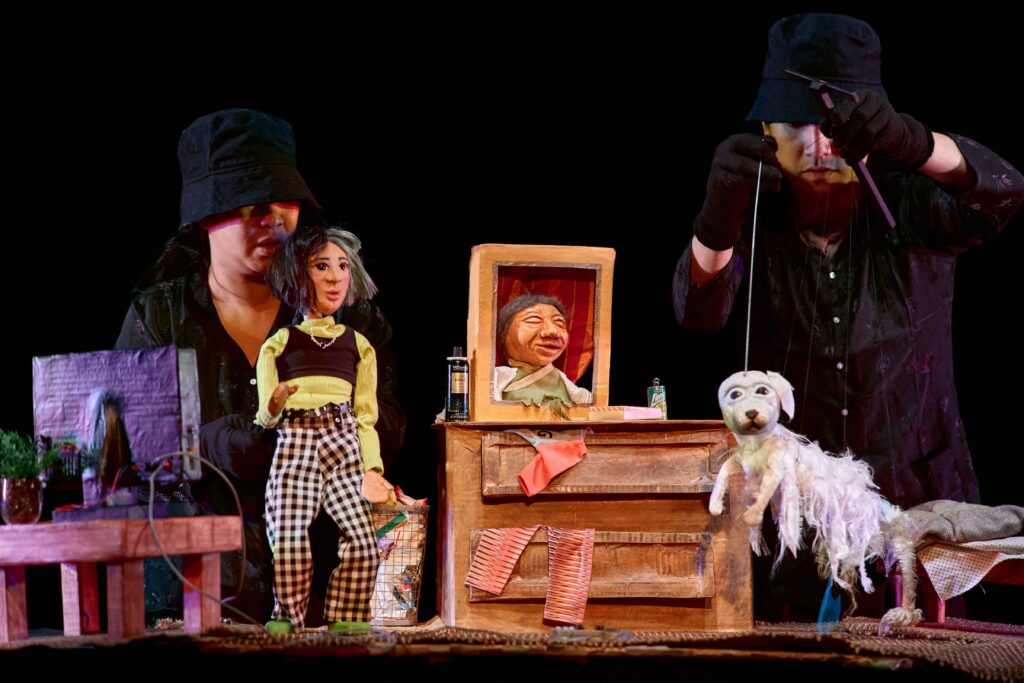
The attention to the practice of tradition and cultural expression was not only a theme of the performance and the play, but of the production’s creation, as we learned during a post-show talkback. During the rehearsal and writing process, Vu and her co-creators discussed at length how much the traditions of the holiday depicted needed to be laid out for a largely non-Vietnamese audience. The choice not to overexplain was wise, as it seemed to encourage the audience’s curiosity and connection; we were allowed to fill in our gaps of knowledge with personal experience. For example, while the majority of audience members may not have celebrated the specific holidays depicted in Phantom Loss, they may know what it feels like to honor cultural traditions with their own families. I imagine the show was all the more powerful for audience members who identified more directly with experiences of Vietnamese Buddhism.
The relationship and growing understanding between Thuy and Chicken reflect the teacherly dynamics at play, with one well-versed in traditions (Chicken) and the other who is hesitant (Thuy). Together, Chicken and Thuy spend a summer becoming close, learning more about the other’s lived experiences—yet they are never quite able to decode Chicken’s previous life as a human. They begin to see each other as confidants and co-conspirators.
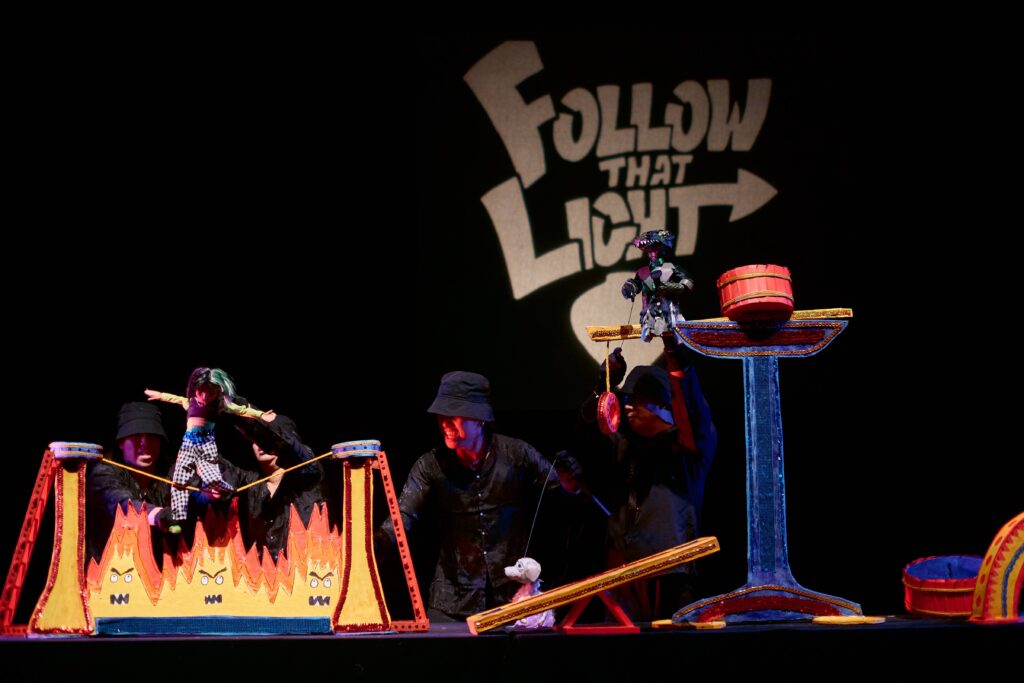
The relationship is heartfelt and loving but time-bound—it is clear that the success of their journey to understand Chicken’s past potentially means the end of their time together when Chicken’s soul is released into the afterlife. The comedy of this tragicomedy asserts itself when the clash between American preteen pop culture and Vietnamese Buddhist tradition climaxes in a surreal homage to 90s-era Nickelodeon game shows. In a scene that recollects a bit of Double Dog Dare and Legends of the Hidden Temple, Chicken and Thuy take on a series of challenges in the form of a neon obstacle course called “Follow that Light!” If they are able to conquer it, Chicken will be free to discover his past and move into the afterlife. The game is hosted by a demon bird named Ma Chim Cay, a many-eyed, shrill-voiced rod puppet who blends magical realism with comedy in an almost archetypal game-show antagonist. Once Chicken and Thuy make their way out of the obstacle course, they are met with the real task of unraveling the traumatic experiences that led Chicken to forget his past.
As we come to the end of the show, there is a stark tone shift along with an invitation to empathize with the refugee experience. In a cinematiclike movement sequence, with Chicken suspended in a swimming motion behind translucent fabric, we see the ghost dog in his former life as a human, undergoing a traumatic and difficult immigration as a refugee to the United States. Near the end of this flashback story, we meet a previously unnamed woman, who is revealed to be his daughter. She honors him through a ritual at an altar, the use of real incense in the theatre inviting us to take part in this thoroughly sensory experience through the sense of smell.
The play concludes with Thuy and Chicken, who is returned to his prior shape as a ghost dog, preparing for Lunar New Year. As they rehearse for a community performance of the traditional Lion Dance, they experience pressure from Thuy’s mother, along with the promise of a Nintendo game. This resolution is apt, as it closes the distance between the world of Thuy’s peers and her parents—not a solution, but a continued honoring of one’s ancestors through interaction with one’s cultural traditions and a shared understanding of how to move forward.
Phantom Limb’s aesthetics and dramaturgical choices situate the storytelling at the crossroads of Vietnamese and American culture. To this point, the presence of a largely Southeast Asian American cast of puppeteers was especially important. Through Vu’s use of puppetry, audience members are invited to see themselves and their inner lives echoed, from Thuy’s teen angst and joy at making a friend to Chicken’s difficult decisions made in times of crisis. While these are not necessarily everyone’s lived experiences, they are ones that we witness and hold space for together, processing the complex emotions and significant sacrifices made by refugees and immigrants all over the world.
Felicia Cooper
Independent Scholar

